


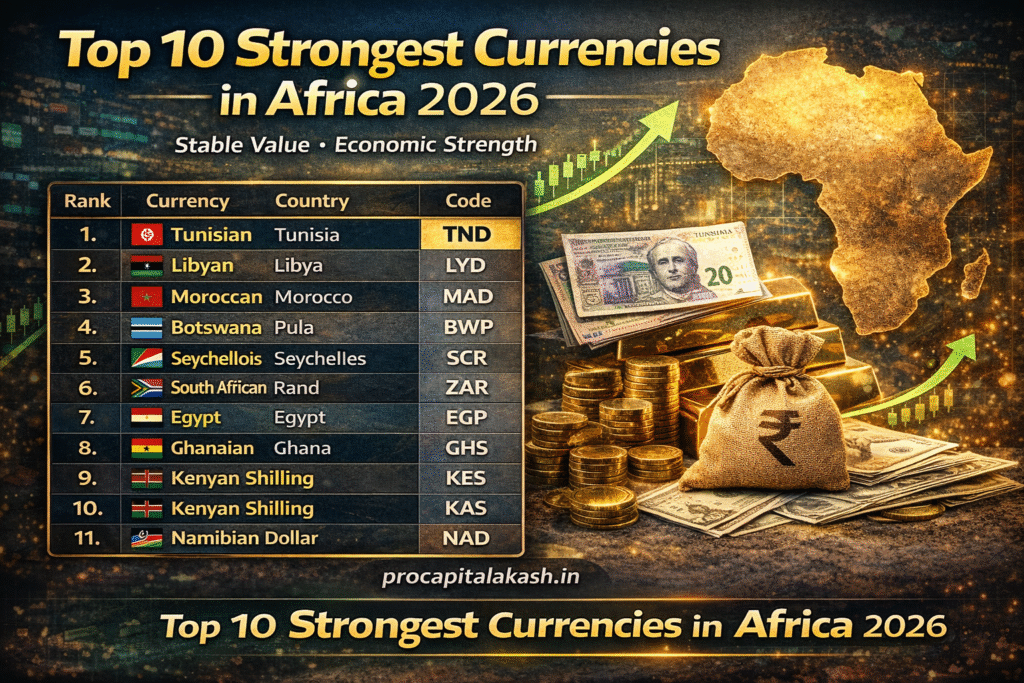
Africa’s economic landscape is evolving rapidly, driven by natural resources, monetary reforms, trade diversification, and fiscal discipline. While many African nations struggle with inflation and currency depreciation, a few have managed to maintain strong, stable, and resilient currencies.
In 2026, the strength of African currencies is influenced by:
- Low inflation control
- Strong foreign reserves
- Stable political and monetary systems
- Commodity exports (gold, oil, diamonds)
- Pegged or managed exchange rate regimes
At Procapitalakash, we analyze currencies not just by exchange rate value, but by real economic strength and stability.
Below is a carefully curated list of the Top 10 Strongest Currencies in Africa in 2026, based on exchange rate strength against the US Dollar, monetary stability, and economic fundamentals.
What Makes a Currency “Strong”?
A currency is considered strong when it shows:
- High value against major global currencies (USD, EUR)
- Low inflation and controlled money supply
- Strong foreign exchange reserves
- Stable political and economic environment
- Confidence from global investors and institutions
Top 10 Strongest African Currencies in 2026
1. Tunisian Dinar (TND) – 🇹🇳 Tunisia
The Tunisian Dinar remains Africa’s strongest currency in terms of exchange rate value. Tunisia tightly controls its currency through central bank policies, limiting excessive devaluation.
Why it’s strong
- Restricted convertibility
- Controlled imports and capital flows
- Strong regulatory oversight
⚠️ Note: High value does not always mean high purchasing freedom.
2. Libyan Dinar (LYD) – 🇱🇾 Libya
Despite political challenges, the Libyan Dinar stays strong due to Libya’s massive oil reserves and government control over foreign exchange.
Why it’s strong
- Oil-backed economy
- Managed exchange rate system
- High per-capita oil revenue
3. Moroccan Dirham (MAD) – 🇲🇦 Morocco
The Moroccan Dirham is one of Africa’s most stable and reliable currencies, supported by a diversified economy and cautious monetary policy.
Why it’s strong
- Tourism, manufacturing, and agriculture
- Gradual currency liberalization
- Strong central bank credibility
4. Botswana Pula (BWP) – 🇧🇼 Botswana
Botswana is often cited as Africa’s best-managed economy. The Botswana Pula benefits from diamond exports and prudent fiscal management.
Why it’s strong
- Diamond-driven foreign reserves
- Low corruption levels
- Sound economic governance
5. Seychellois Rupee (SCR) – 🇸🇨 Seychelles
The Seychellois Rupee has gained strength due to tourism recovery and successful debt restructuring with international institutions.
Why it’s strong
- Tourism-led forex inflows
- IMF-backed reforms
- Improved fiscal discipline
6. South African Rand (ZAR) – 🇿🇦 South Africa
Although volatile, the South African Rand remains one of Africa’s most liquid and globally traded currencies, making it relatively strong in real terms.
Why it’s strong
- Deep financial markets
- Commodity exports (gold, platinum)
- Strong banking system
7. Egyptian Pound (EGP) – 🇪🇬 Egypt
After major currency reforms and IMF-led restructuring, the Egyptian Pound has stabilized significantly heading into 2026.
Why it’s strong
- IMF support programs
- Tourism and Suez Canal revenues
- Improved forex reserves
8. Ghanaian Cedi (GHS) – 🇬🇭 Ghana
Once among Africa’s weakest currencies, the Ghanaian Cedi has rebounded due to fiscal reforms and better commodity management.
Why it’s strong
- Gold and cocoa exports
- Debt restructuring progress
- Inflation control measures
9. Kenyan Shilling (KES) – 🇰🇪 Kenya
The Kenyan Shilling has shown resilience backed by East Africa’s largest economy and strong diaspora remittances.
Why it’s strong
- Diverse economy
- High remittance inflows
- Regional trade leadership
10. Namibian Dollar (NAD) – 🇳🇦 Namibia
The Namibian Dollar is pegged to the South African Rand, benefiting from South Africa’s financial system and trade integration.
Why it’s strong
- Currency peg stability
- Mining and resource exports
- Fiscal discipline
🔹 Comparison Table: Strongest African Currencies in 2026
| Rank | Currency | Country | ISO Code | Key Strength Factor |
|---|---|---|---|---|
| 1 | Tunisian Dinar | Tunisia | TND | Controlled exchange rate |
| 2 | Libyan Dinar | Libya | LYD | Oil-backed economy |
| 3 | Moroccan Dirham | Morocco | MAD | Economic diversification |
| 4 | Botswana Pula | Botswana | BWP | Diamond reserves |
| 5 | Seychellois Rupee | Seychelles | SCR | Tourism & IMF reforms |
| 6 | South African Rand | South Africa | ZAR | Market liquidity |
| 7 | Egyptian Pound | Egypt | EGP | IMF-led stabilization |
| 8 | Ghanaian Cedi | Ghana | GHS | Gold & cocoa exports |
| 9 | Kenyan Shilling | Kenya | KES | Remittances & trade |
| 10 | Namibian Dollar | Namibia | NAD | Pegged to ZAR |
Why Currency Strength Matters
A strong currency:
- Lowers import costs
- Controls inflation
- Attracts foreign investment
- Enhances economic confidence
However, over-controlled currencies may restrict trade freedom, so balance is key.
Key Risks to Watch in African Currencies
- Political instability
- Commodity price fluctuations
- High external debt
- Global interest rate changes
- Climate-related economic shocks
Final Thoughts
In 2026, Africa presents a mixed currency landscape. While some nations continue to face depreciation pressures, others have built resilient, well-managed currencies through reforms, diversification, and disciplined monetary policy.
For investors, traders, and global businesses, understanding currency strength is critical for risk management and long-term planning.
At Procapitalakash.in, we track global economic trends to help you stay informed—not influenced by noise, but guided by data.
Disclaimer
This article is for educational and informational purposes only and should not be considered financial or investment advice. Currency values are subject to market risk and geopolitical changes.