


A Defining Moment in Global Economic History
A quiet but historic transformation is underway in the global economic.
For decades, Japan symbolized economic dominance in Asia—a nation that rebuilt itself from war into the world’s most advanced industrial powerhouse. Today, that era has officially turned a page.
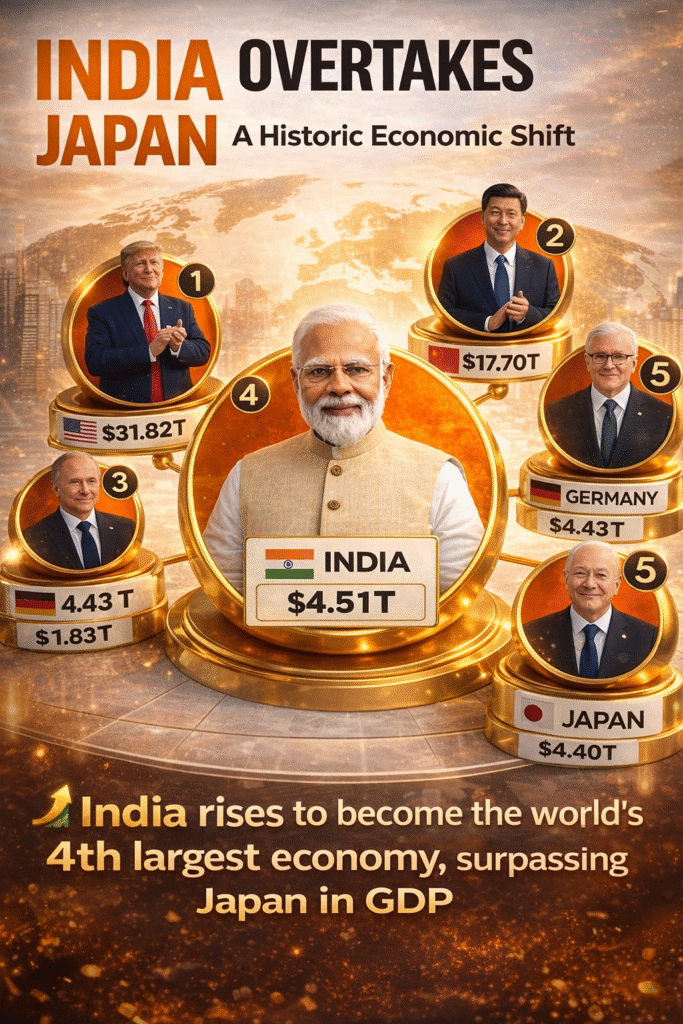
India has overtaken Japan in economic size, emerging as one of the world’s largest economies and signaling a dramatic shift in global power dynamics.
This moment is not just about rankings on a chart. It reflects deeper forces reshaping the world: demographics, technology, consumption, geopolitics, and the reordering of global supply chains.
For investors, businesses, policymakers, and everyday citizens, this milestone answers one big question—and raises many more:
👉 Is India becoming the next global economic superpower?
ALSO READ – TOP 50 Penny STOCK 2026
What “India Overtakes Japan” Actually Means
Before diving into implications, it’s important to clarify what this milestone represents.
Understanding Nominal GDP
The comparison refers to nominal Gross Domestic Product (GDP)—the total value of goods and services produced by a country, measured in current US dollars.
Nominal GDP matters because it reflects:
- Global purchasing power
- Financial influence
- Ability to attract capital
- Economic weight in international institutions
In nominal terms, India’s GDP has crossed roughly $4.5 trillion, overtaking Japan, whose economy has been weighed down by currency depreciation and slow growth.
A Snapshot of the New Global Economic Order
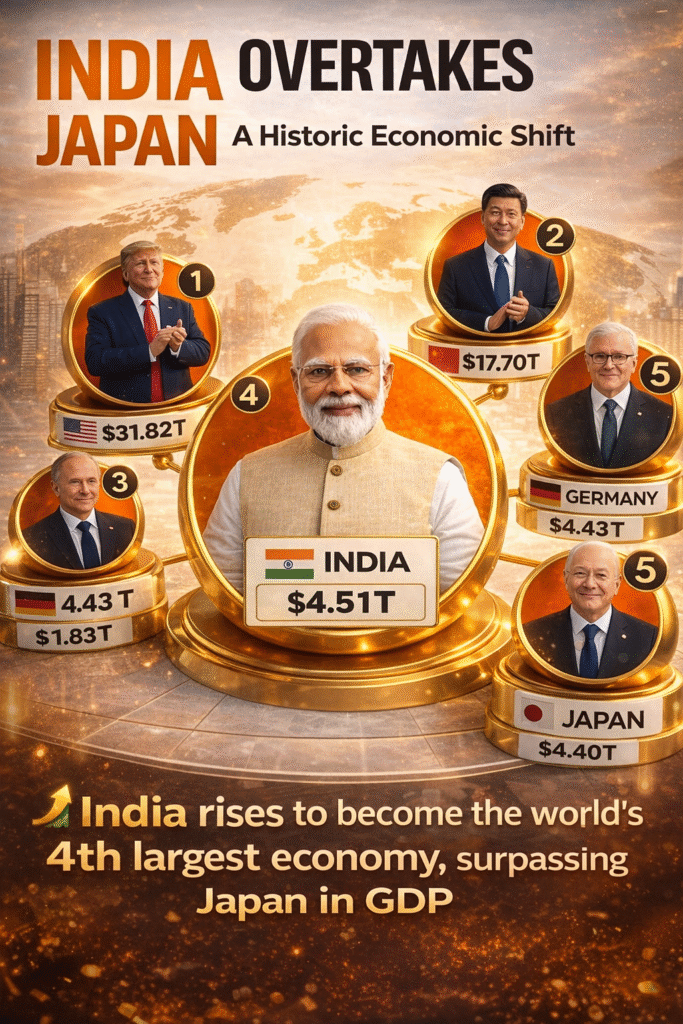
Top Global Economies (Nominal GDP – Approx.)
- United States
- China
- Germany
- India
- Japan
- United Kingdom
- France
- Italy
- Canada
- Russia
What stands out is not just India’s rise—but how quickly it happened.
Twenty years ago, India wasn’t even in the top ten.
Two Economies, Two Very Different Stories
Japan: The Limits of a Mature Economy
Japan’s economy remains advanced, innovative, and highly productive. However, it faces structural headwinds:
- Median age above 48
- Declining population
- Shrinking workforce
- Persistent deflationary pressures
- Government debt exceeding 250% of GDP
Japan’s growth is steady—but slow. Its economy expands at less than 1% annually, making it difficult to keep pace with fast-growing emerging markets.
India: The Momentum Economy
India’s story is the opposite.
- Median age: ~28
- World’s largest working-age population
- Rapid urbanization
- Expanding middle class
- Technology-led growth
- Consumption-driven demand
India consistently grows at 6–7%, making it the fastest-growing major economy in the world.
This growth is not cyclical—it is structural.
The Five Forces Powering India’s Economic Surge
1. Demographics: India’s Greatest Competitive Advantage
India’s population is often discussed as a challenge—but economically, it is a massive asset.
- Over 65% of Indians are under 35
- Millions join the workforce each year
- Rising literacy and digital skills
- Expanding entrepreneurial base
This demographic engine fuels:
- Consumption
- Housing demand
- Credit growth
- Tax revenues
No other large economy has this combination of scale + youth.
2. Domestic Consumption: The Backbone of Growth
Unlike export-heavy economies, India’s growth is powered from within.
Key drivers include:
- FMCG and retail
- Housing and real estate
- Automobiles and EVs
- Healthcare and pharmaceuticals
- Financial services and insurance
As incomes rise, discretionary spending increases—creating a self-reinforcing growth cycle.
3. Manufacturing Revival: From Importer to Exporter
India is repositioning itself as a global manufacturing hub.
Major catalysts:
- Production Linked Incentive (PLI) schemes
- China+1 supply chain diversification
- Electronics and semiconductor push
- Defense and aerospace manufacturing
- Renewable energy equipment
Global companies are no longer asking if they should manufacture in India—but how fast.
4. Digital Infrastructure: India’s Silent Revolution
India has built one of the world’s most advanced digital public infrastructures:
- Aadhaar (digital identity)
- UPI (real-time payments)
- DigiLocker
- Account Aggregator framework
This ecosystem has:
- Reduced transaction costs
- Improved financial inclusion
- Enabled fintech innovation
- Increased formalization of the economy
India didn’t just digitize—it leapfrogged.
5. Infrastructure Boom: Laying the Physical Foundation
Economic growth needs roads, ports, power, and logistics—and India is investing heavily.
- Expressways and highways
- Rail and metro expansion
- Airport modernization
- Port capacity growth
- Dedicated freight corridors
This infrastructure build-out improves productivity and reduces friction across industries.
Currency Dynamics: Why the Yen Fell Behind
One key reason Japan slipped behind India in nominal GDP rankings is currency depreciation.
- The Japanese yen weakened significantly against the US dollar
- Nominal GDP measured in USD declined even as domestic output remained stable
India’s currency, while not immune to volatility, has remained relatively stable due to:
- Strong growth
- Capital inflows
- Rising foreign exchange reserves
This highlights why nominal GDP rankings are as much about currency strength as economic output.
What This Means for Global Investors
India as a Core Allocation
Global investors increasingly view India as:
- A long-term growth story
- A diversification hedge
- A demographic-driven economy
- A stable democracy with reform momentum
India is no longer an “emerging market bet”—it is becoming a core portfolio allocation.
Equity Markets: Earnings, Not Just Valuations
India’s stock market strength is supported by:
- Corporate earnings growth
- Strong balance sheets
- Formalization benefits
- Rising retail participation
Sectors seeing strong investor interest:
- Banking & NBFCs
- Capital goods
- Infrastructure
- IT services
- Manufacturing & EMS
- Renewable energy
Bond Markets & Capital Flows
India’s inclusion in global bond indices is expected to:
- Attract billions in passive inflows
- Lower borrowing costs
- Improve market depth
- Increase currency stability
Geopolitical Implications of India’s Rise
Economic power translates into strategic influence.
India’s growing GDP strengthens its position in:
- Global trade negotiations
- Defense partnerships
- Supply chain diplomacy
- Multilateral institutions (G20, IMF, World Bank)
India is no longer just balancing power—it is shaping outcomes.
Challenges That Could Slow India’s Momentum
No growth story is without risks.
Key Challenges Ahead
- Job creation pace vs population growth
- Skill mismatch in the labor force
- Urban congestion and housing pressure
- Income inequality
- Climate and energy transition costs
India’s success depends on execution, not just intent.
Can India Become the World’s Third-Largest Economy?
Most global projections suggest:
- India could surpass Germany within this decade
- Nominal GDP could reach $7–8 trillion by early 2030s
- PPP-adjusted GDP may eventually rival China and the US
The direction is clear—even if timelines vary.
Why This Moment Matters More Than a Ranking
India overtaking Japan is not just a statistic.
It represents:
- The rise of emerging markets
- The shift of economic gravity toward Asia
- The power of demographics and consumption
- The payoff of long-term reforms
For the first time in modern history, a developing nation is reshaping the global economic hierarchy at scale.
Final Thoughts: India’s Growth Story Is Still in Its Early Chapters
India’s ascent is not the end of a journey—it is the beginning of a much larger one.
The next decade will determine:
- How inclusive the growth is
- How sustainable it becomes
- How effectively opportunities are distributed
But one thing is clear:
India is no longer catching up. India is setting the pace.
Google Discover–Optimized FAQ Section
Is India officially larger than Japan’s economy?
Yes, based on nominal GDP projections, India has overtaken Japan.
Why did Japan fall behind despite being developed?
Slow growth, aging demographics, and a weaker yen reduced Japan’s nominal GDP ranking.
Is India the fastest-growing major economy?
Yes, among large economies, India leads in growth rate.
Does this mean Indians are richer than Japanese?
No. Per capita income in Japan remains significantly higher.
Will India overtake Germany next?
Many forecasts suggest India could surpass Germany within a few years.
How does this impact Indian stock markets?
Strong economic growth supports long-term equity and earnings expansion.
Is this growth sustainable long term?
Yes, if reforms, job creation, and infrastructure development continue.
Why does Google Discover favor this topic?
It combines fresh economic data, global relevance, strong visuals, and investor interest.